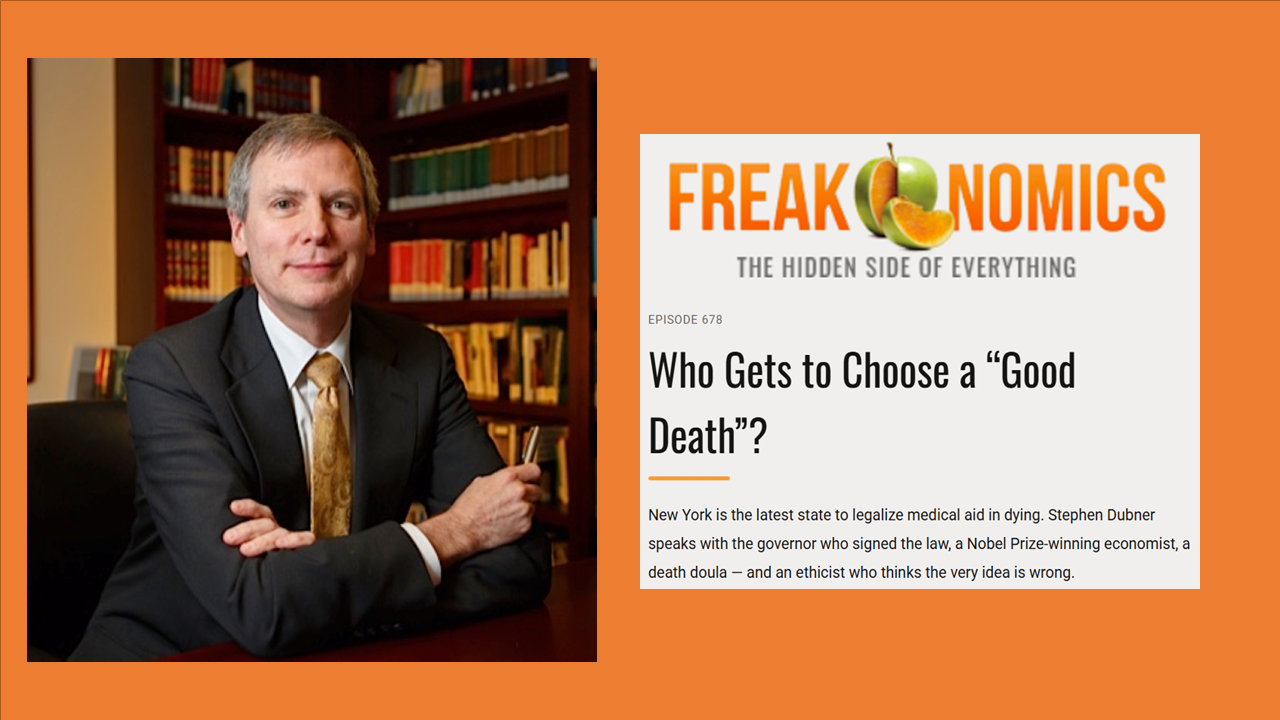
Sulmasy provides critical perspective on assisted suicide on NPR’s popular “Freakonomics” podcast
Kennedy Institute of Ethics director and André Hellegers Professor of Biomedical Ethics Daniel P. Sulmasy, MD, PhD, gave an extensive interview outlining his position opposing assisted suicide on the well-known NPR podcast Freakonomics, in an episode titled “Who Gets to Choose a ‘Good Death’?” and published June 19, 2026.
I think it’s bad medicine because at this point in history we can do more than we have ever been able to do to treat patient symptoms, and the data will bear out that the reason people want euthanasia or assisted suicide when they actually follow through are reasons like loss of control, feeling like a burden to other people, loss of autonomy. These are not medical diagnoses, and they’re not good reasons to give lethal medication. I also think that it’s bad medicine because the trust that is necessary for a patient to be able to bare their body, bare their soul, all their intimate secrets, before a physician requires some very fundamental basic rules. And these go back to Hippocrates. In a nutshell, the Hippocratic oath says, I won’t disclose your secrets, I won’t have sex with you, and I won’t kill you. And that’s the bottom line. —Daniel P. Sulmasy, from the podcast
The episode also features interviews with Kathy Hochul, governor of New York, Al Roth , economist at Stanford University, and Suzanne O’Brien, death doula and founder of Doulagivers Institute.
About the podcast:
Freakonomics began as a book, which led to a blog , a documentary film , and in 2010 a podcast called Freakonomics Radio . It is hosted by author and journalist Stephen J. Dubner, and is one of the most popular podcasts in the world. Its archive of more than 500 episodes is available, for free, on any podcast app, and the show airs weekly on NPR stations .